 DALON
DALONHow to Choose the Right Sintered Bronze Bushing for Your Application
How to Choose the Right Sintered Bronze Bushing for Your Application
Choosing a bushing sounds simple until the application starts asking difficult questions. Will the shaft run quietly enough? Is external lubrication practical? What happens if the environment is dusty, humid, or hot? Will a low-cost self-lubricating bushing actually reduce maintenance, or will it create early wear and field complaints?
That is why engineers and technical buyers often search for how to choose sintered bronze bushing options more carefully. They are usually not looking for a basic definition. They are trying to avoid the wrong choice. A sintered bronze bushing can be an excellent bearing solution in many applications, but only when load, speed, shaft condition, environment, and service expectations are properly matched to the design.
Sintered bronze bushings are widely used because they offer a practical combination of compact size, self-lubricating behavior, production efficiency, and low-maintenance operation in suitable service. But “self-lubricating” does not mean universally suitable. A bronze bushing that performs well in a fan motor or a light industrial assembly may be the wrong choice for a high-load, heavily contaminated, or shock-loaded system.
This guide explains how to choose the right sintered bronze bushing for your application, what selection factors matter most, when the technology is a strong fit, and when another bearing solution may be a better long-term decision.
What a Sintered Bronze Bushing Is Designed to Do
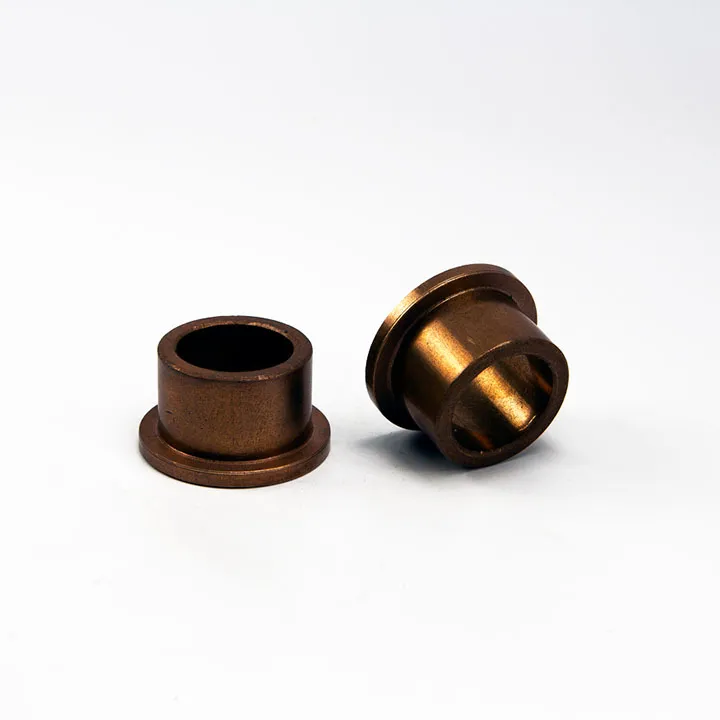
A sintered bronze bushing is a porous plain bearing made by powder metallurgy. Bronze powder is compacted into shape and sintered into a rigid but porous structure. In many applications, that porous body is impregnated with lubricating oil so the bushing can support self-lubricating operation.
Its basic design purpose is to provide:
- shaft support
- low-maintenance bearing behavior
- compact integration into an assembly
- oil-retaining lubrication in suitable conditions
- practical cost in repeated production
This makes it especially useful where the designer wants a simpler bearing system than a more complex rolling-element arrangement, and where external lubrication is inconvenient or undesirable.
The most important thing to understand is that a sintered bronze bushing is not selected only by size. It must be selected by application fit.
Start with the Real Function, Not the Catalog
One of the most common mistakes in bearing selection is starting with a catalog size and only later thinking about the operating duty.
A better starting point is to ask:
- What exactly is the bushing expected to do?
- Is the shaft lightly supported or heavily loaded?
- Is the motion continuous, intermittent, or start-stop?
- Is low maintenance the main goal?
- Is quiet running important?
- Is the assembly sealed, dusty, hot, or exposed to vibration?
These questions matter because the “right” sintered bronze bushing is not just the one that fits the housing bore. It is the one that matches the full operating logic of the equipment.
Why Sintered Bronze Bushings Are Often Chosen
Engineers and procurement teams usually choose sintered bronze bushings for practical reasons rather than theoretical ones.
Typical reasons include:
- self-lubricating bearing concept
- compact design
- quiet operation in suitable applications
- reduced need for frequent relubrication
- cost efficiency in production
- simple installation in many OEM assemblies
- broad availability of standard sleeve formats
This is why they are common in:
- small electric motors
- fans and blowers
- appliances
- automotive subassemblies
- light industrial machinery
- conveyors and packaging equipment
- actuators and compact motion systems
However, wide use does not mean universal suitability. The selection still has to be checked against the real operating conditions.
The Most Important Selection Factors
1. Load
Load is one of the first things to review, and it should be evaluated realistically.
Do not look only at the nominal static load. Also consider:
- radial load
- axial influence where relevant
- dynamic load variation
- shock loading
- startup peaks
- misalignment-related loading
A sintered bronze bushing is often a strong fit in light to moderate-duty applications. As load becomes heavier or more erratic, the bearing concept may need closer review.
In many field failures, the issue is not that the bronze material was poor. The issue is that the actual load pattern was harsher than the design assumption.
2. Speed
Speed should never be reviewed alone. It always matters together with load, duty cycle, and temperature.
A moderate-speed application may be well suited to a sintered bronze bushing if the load is reasonable and the environment is controlled. The same speed may be much more demanding if:
- load is higher
- the shaft is poorly aligned
- duty is continuous
- temperature rises significantly
- lubrication margin is reduced by contamination
This is one reason why general “RPM limits” can be misleading without context. A bearing decision should be based on the real operating combination, not one isolated number.
3. Shaft Condition
A high-quality bushing cannot compensate for a poorly prepared shaft forever.
The shaft influences:
- friction behavior
- running noise
- oil film stability
- wear pattern
- long-term performance consistency
Key shaft considerations usually include:
- surface finish
- dimensional accuracy
- alignment
- hardness where relevant
- cleanliness during assembly
If the shaft is rough, misaligned, or dimensionally unstable, even the correct bushing can perform badly. In many troubleshooting cases, what looks like “bushing failure” is partly a shaft quality problem.
4. Duty Cycle
How the equipment runs matters just as much as how fast it runs.
Useful questions include:
- Is the system continuous duty or intermittent?
- Does it stop and start frequently?
- Does it see frequent acceleration and deceleration?
- Is idle time long enough for lubricant redistribution?
- Is the motor or machine expected to run quietly for long periods?
A sintered bronze bushing is often attractive in applications where low-maintenance, moderate-duty operation is the priority. But duty cycle still matters. A start-stop pattern can create different demands from smooth continuous running.
5. Environment
The environment has a major influence on whether a sintered bronze bushing is a practical long-term solution.
Things to review include:
- dust
- humidity
- contamination
- chemical exposure
- temperature variation
- risk of liquid ingress
- outdoor vs indoor service
A porous self-lubricating bearing concept often works best in relatively controlled conditions. If the environment becomes highly contaminated or chemically aggressive, the application deserves a more cautious review.
This does not mean bronze bushings cannot be used in industrial settings. It means the environment should be treated as a serious design factor, not an afterthought.
6. Temperature
Temperature affects both the bearing material behavior and the lubricant retained inside the porous structure.
This is why a general temperature statement should never be treated as universal. The right engineering question is not “What broad temperature range is sometimes mentioned?” The better question is:
Will the actual application temperature allow the oil-impregnated porous bearing concept to work reliably over time?
If the system sees heat build-up, thermal cycling, or hotter local zones near the shaft, that should be reviewed honestly.
7. Noise and Vibration Expectations
In many applications, a sintered bronze bushing is chosen because it supports quieter operation than some alternative bearing concepts in suitable service.
This is especially relevant in:
- fan motors
- appliance drives
- compact OEM equipment
- office or indoor-use machinery
- low-noise actuation systems
But the noise result is not automatic. It depends on:
- shaft condition
- fit
- alignment
- load
- operating speed
- housing rigidity
If the system is poorly aligned or overloaded, the “quiet bearing” may no longer be quiet.
8. Installation Method
Installation matters more than many buyers expect.
Review:
- press-fit logic
- bore tolerance
- shaft fit
- installation alignment
- cleanliness during assembly
- whether future replacement is expected
A good bushing in a poorly controlled installation process may create performance inconsistency from one unit to the next. This is especially important for OEMs where repeatability in production matters as much as nominal design intent.
When a Sintered Bronze Bushing Is Usually the Right Choice
A sintered bronze bushing is often the right choice when the application needs:
- self-lubricating behavior
- compact plain-bearing design
- low-maintenance operation
- practical cost in production
- moderate load and speed conditions
- quiet running in suitable environments
- simple and repeatable integration into an OEM assembly
This is why it remains a strong choice in small motors, appliances, light industrial equipment, and many compact machine designs.
If the application priorities are simplicity, stable cost, and reduced lubrication maintenance, the bronze bushing concept often becomes very attractive.
When Another Solution May Be Better
A good selection guide must also say where the limits begin.
A different bearing solution may be better when:
- the application is heavily loaded
- the speed-load combination is very demanding
- shock loading is severe
- the environment is highly contaminated
- chemical exposure is aggressive
- the design requires a different friction or precision behavior
- external lubrication is already part of the machine logic
- a rolling-element bearing is more appropriate for the duty
This is not a weakness of sintered bronze. It is simply good engineering fit. Every bearing technology has an application zone where it makes the most sense.
Sintered Bronze Bushing vs Ball Bearing
This is one of the most common comparison points in commercial investigation.
Why choose a sintered bronze bushing instead of a ball bearing?
- simpler design
- lower maintenance logic
- quieter running in many suitable applications
- more compact packaging in some assemblies
- cost efficiency in repeated production
Why choose a ball bearing instead?
- higher-demand load and speed conditions
- different friction behavior requirements
- higher-performance duty cycle
- application-specific durability priorities
The right answer depends on the system. A ball bearing is not automatically “better,” and a bronze bushing is not automatically “simpler and cheaper” in lifecycle terms unless the application matches.
Sintered Bronze Bushing vs Machined Bronze Bushing
This is another important comparison.
Why choose sintered bronze?
- porous oil-retaining structure
- self-lubricating behavior
- efficient for repeated production
- strong fit for low-maintenance design logic
Why choose machined bronze?
- dense material
- may suit low-volume or custom work better
- may be preferred where a different lubrication strategy is already planned
- useful when geometry or production volume does not suit powder metallurgy
The decision is not just material-based. It is also manufacturing-logic-based.
Common Buyer Mistakes
Mistake 1: Choosing only by dimension
A bushing that fits physically may still be wrong for load, speed, or environment.
Mistake 2: Treating self-lubricating as maintenance-proof
Self-lubrication is a design advantage, not an unlimited performance claim.
Mistake 3: Ignoring shaft and housing quality
The bearing system is more than the bushing alone.
Mistake 4: Underestimating contamination
Dust, moisture, and poor assembly cleanliness can undermine performance.
Mistake 5: Comparing unit price without comparing system impact
A seemingly cheaper choice can become more expensive if it increases maintenance, wear, or field returns.
How to Choose More Reliably
If you want to choose sintered bronze bushing options more reliably, use this decision path:
Step 1: Define the operating duty
Light, moderate, or severe? Continuous or intermittent? Quiet-running or not?
Step 2: Review load and speed together
Do not assess them separately.
Step 3: Check shaft quality and fit
A good shaft-bearing pair matters more than a good bushing alone.
Step 4: Review the environment
Dust, humidity, heat, and contamination can change the whole decision.
Step 5: Compare lifecycle logic
Are you optimizing for unit price, low maintenance, quiet running, or assembly simplicity?
Step 6: Ask what happens if the assumption is wrong
If the bearing is underselected, what is the cost? If it is overselected, what is the penalty?
This kind of decision framework is far more useful than choosing by habit.
Engineering Tools for Bushing Selection
If you are evaluating dimensions, fit, or estimated part weight for a sintered bronze bushing project, the following internal tools may be useful during design and quotation review:
FAQ
How do I choose the right sintered bronze bushing?
Start by reviewing load, speed, shaft condition, duty cycle, environment, installation method, and maintenance expectations together rather than selecting by size alone.
What is the biggest advantage of a sintered bronze bushing?
For many applications, the biggest advantage is practical self-lubricating operation combined with compact, low-maintenance design.
Are sintered bronze bushings good for all applications?
No. They are best suited to applications where load, speed, environment, and maintenance goals align with the self-lubricating porous bearing concept.
How important is shaft finish when selecting a bronze bushing?
Very important. Shaft condition directly affects friction, wear, noise, and overall bearing performance.
Are sintered bronze bushings better than ball bearings?
Not universally. They are often better in suitable low-maintenance, moderate-duty applications, while ball bearings may be better in more demanding conditions.
What environments are not ideal for sintered bronze bushings?
Highly contaminated, chemically aggressive, or otherwise severe environments often require more caution or a different bearing solution.
Do I still need to think about maintenance with a self-lubricating bushing?
Yes. “Self-lubricating” reduces lubrication burden, but application fit, contamination control, and inspection still matter.
When should I choose a machined bronze bushing instead?
A machined bronze bushing may be the better choice when production volume is low, custom machining is more practical, or the application uses a different lubrication logic.
Conclusion
To choose the right sintered bronze bushing for your application, start with the real operating conditions rather than the catalog. The correct choice depends on how load, speed, shaft condition, environment, temperature, installation quality, and maintenance goals work together in the actual machine.
Sintered bronze bushings are often an excellent solution when the application values self-lubrication, compact design, quiet operation, and low-maintenance service. They are not universal, but in the right duty range they can be one of the most practical and cost-effective bearing choices available.
For engineers, technical procurement teams, and equipment manufacturers, the best decision is rarely made by asking “Will a sintered bronze bushing fit?” The better question is “Will this bearing concept support the real duty, real environment, and real lifecycle goals of the application?” That question usually leads to a much better selection decision.